🧱 Core Concepts & Architecture
📖 Section Introduction
This module covers the core concepts and fundamental layout of building out scalable clusters in Kubernetes.
- Cluster Architecture
- API Primitives
- Services and Other Network Primitives
🔗 Official Reference Documentation
We strongly recommend bookmarking these for the open-book exam: - Kubernetes API Overview - Working with Kubernetes Objects - Kubernetes Architecture - Kubernetes Components Overview - Services & Networking
🏛️ Cluster Architecture
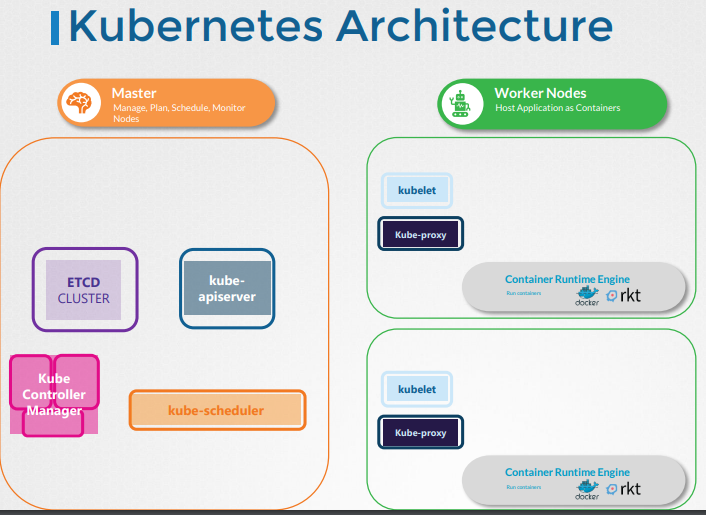
The Kubernetes cluster architecture is divided into two main segments: the Master Node and the Worker Nodes.
1. Master Node Components
The master node hosts several control plane components that oversee the entire Kubernetes cluster. It monitors all nodes, decides where applications should be deployed, and continuously supervises the cluster.
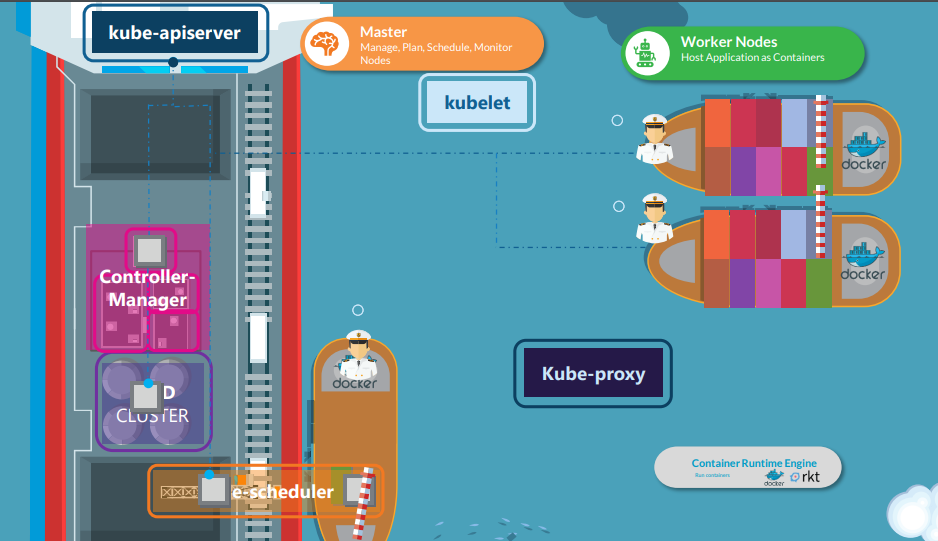
[!tip] Consider the master node as the central command center coordinating an entire fleet of cargo ships.
In a busy port, numerous containers are loaded and unloaded daily. Kubernetes keeps detailed information about each container and its assigned node in a highly available key-value store called etcd.
etcd: Utilizes a simple key-value format combined with a quorum mechanism, ensuring reliable and consistent data storage throughout the cluster.
When a new container (or "ship cargo") is ready, the Kubernetes scheduler—similar to a massive port crane—determines which worker node should host it. The scheduler considers current load, resource requirements, and specific constraints such as taints, tolerations, or node affinity rules. This scheduling process is crucial for the cluster’s efficient operation.
🔑 Key Master Components
| Component | Responsibility |
|---|---|
| ETCD Cluster | Stores cluster-wide configuration and state data. |
| Kube Scheduler | Selects the optimal node for new container deployments. |
| Controllers | Manages node lifecycle, container replication, and system stability. |
| Kube API Server | Serves as the central hub for cluster communication and management. |
2. Worker Node Components
Worker nodes, comparable to the cargo ships themselves, are responsible for actually running the containerised applications. Each node is managed by the kubelet, the node’s "captain," which ensures containers operate exactly as directed.
🔑 Key Worker Components
| Component | Responsibility |
|---|---|
| Kubelet | Oversees the lifecycle of containers on each node. It receives instructions from the Kube API server to create, update, or remove containers and regularly reports the node’s status. |
| KubeProxy | Configures networking rules on worker nodes, thus enabling smooth inter-container communication across nodes. For instance, it allows a web server on one node to interact with a database on another. |
📝 Architecture Summary Recap
- Master Node: Centralized control and management of the entire cluster.
- Key Components: etcd, kube-scheduler, controllers, kube-apiserver.
- Worker Node: Responsible for the life-cycle management of containers and ensuring network communication between services.
- Key Components: kubelet, kube-proxy.